
Advanced Link Building Tactics - What Actually Works
I've spent years refining advanced link building tactics. These aren't quick fixes—they require strategic outreach, content upgrades, and solving editorial problems to earn high-quality backlinks. In this guide, I cover the skyscraper technique, unlinked mentions, broken-link building, link insertions, and resource-page outreach, detailing execution, effectiveness, and risk management.
Every tactic here is manual. No shortcuts, no networks. I'll tell you what works, why it works, and where most people waste time.
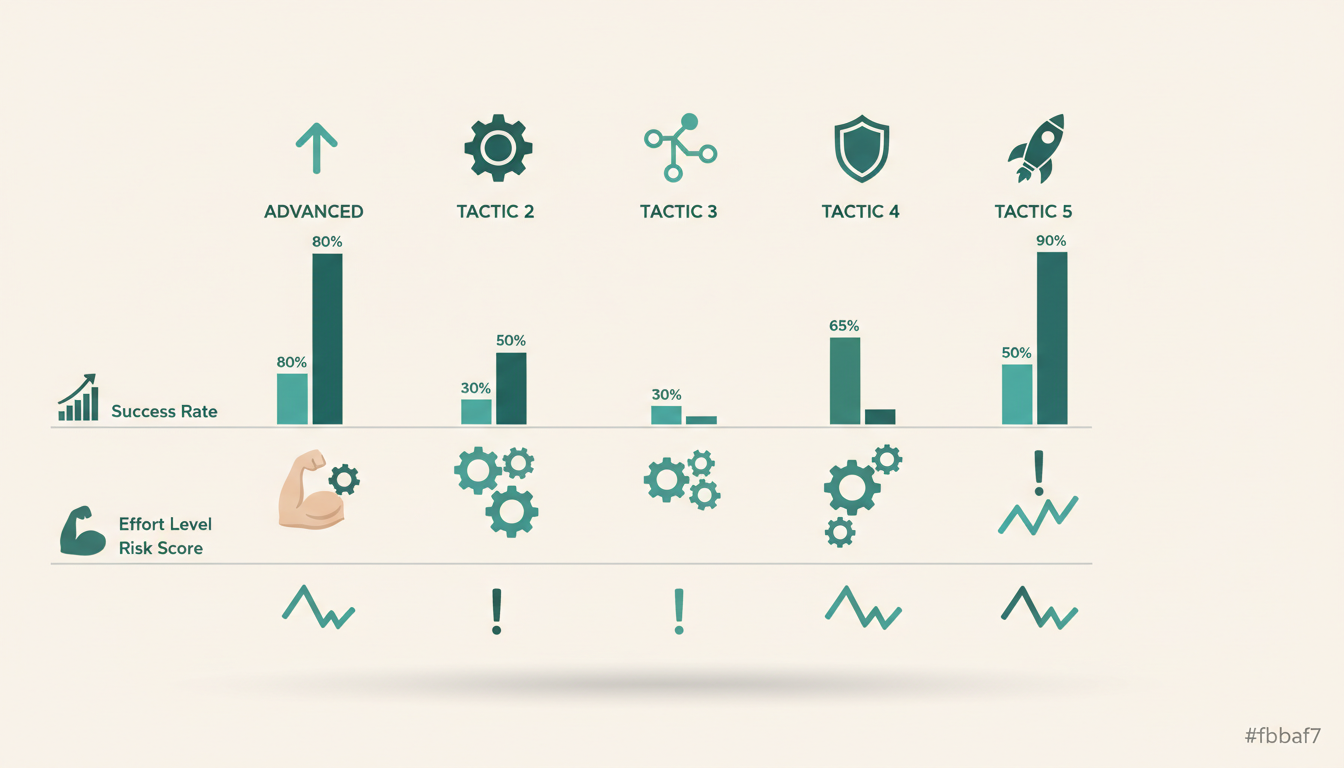
At a glance
- Best ROI Tactic
- Unlinked mentions (low effort, high success rate)
- Highest Risk
- Undisclosed paid link insertions
- Typical Success Rate
- 5-15% for cold outreach
Core Advanced Tactics
Five proven methods dominate advanced link building:
- Skyscraper Technique: Create superior content, then pitch sites linking to inferior competitors. See my skyscraper technique guide.
- Unlinked Mentions: Convert existing brand citations into backlinks. I cover this in unlinked mentions.
- Broken Link Building: Replace dead links with your relevant resource. More at broken link building.
- Link Insertions: Add contextual links to existing articles. Read link insertions.
- Resource Page Outreach: Get listed on curated industry resource hubs. See resource page link building.
Execution Framework
All advanced tactics follow this workflow:
- Prospecting: Use backlink tools or search operators to find targets. I rely on tools I use.
- Qualification: Verify relevance, traffic, and link potential. My link judgment framework helps.
- Content Preparation: Ensure your asset solves the target's need.
- Outreach: Customize pitches to each opportunity. See my outreach & PR page.
- Tracking: Monitor live links and adjust strategy.
Risk Assessment
Google allows links earned through editorial merit but penalizes manipulation. Key risks:
- Undisclosed paid links (violate Google guidelines)
- Irrelevant placements (low value, may be removed)
- Over-optimized anchor text (appears manipulative)
- Spammy outreach (harms brand reputation)
I discuss more in risk & hats.
Performance Benchmarks
Typical results by tactic (based on industry studies):
- Skyscraper: 8-12% success rate (requires exceptional content)
- Unlinked Mentions: 15-25% success (easiest wins)
- Broken Links: 10-15% success (depends on link quality)
- Resource Pages: 5-10% success (high competition)
These are averages. Your mileage depends on niche, content quality, and outreach skill.
When to Use Each Tactic
Choosing the right tactic depends on your assets and goals:
- Skyscraper: Use when competitor pages already have links and you can create something genuinely better. See link earning.
- Unlinked mentions: Best for brands already being talked about. Quick wins.
- Broken link building: Good for resource pages and pages with obvious 404s.
- Link insertions: Useful when you have a highly relevant page and a cooperative publisher.
- Resource page outreach: Best for guides, tools, checklists, and reference content.
- Guest posting: Works better for brands, founders, and subject-matter experts. See manual link building.
Common Mistakes to Avoid
Even experienced link builders fall into these traps:
- Over-optimized outreach: Most prospects ignore irrelevant pitches. Personalize every email.
- Weak content: Using poor content as a skyscraper target usually fails. No editor replaces a reference with something worse.
- Ignoring relevance: A link from a relevant page with real traffic is worth more than ten from random directories.
- Not tracking: Monitor live links, not just replies. Adjust strategy based on what actually sticks.
For more on scaling safely, see scale link building and natural link building.
Advanced link-building tactics
Advanced tactics vary in effort, cost, and risk:
| Tactic | Best use case | Effort | Cost | Risk | Typical fit |
|---|---|---|---|---|---|
| Skyscraper techniqueCreate a materially better resource than pages already earning links, then pitch the current linkers.[10][7] | Content upgrade + link reclamation | High | Medium to high | Mainly content production + outreach | Low to medium |
| Unlinked mentionsTurn existing brand mentions into backlinks by asking publishers to add the link.[10][7] | Brand cleanup + easy wins | Low to medium | Low | Low | Low |
| Link insertionsGet a relevant contextual link placed into an existing page that already gets traffic or links.[10] | Fast editorial placement | Medium | Medium | Medium | Medium |
| Broken link buildingReplace dead outbound links with your live, relevant alternative.[10][3] | Fix a problem on someone else's page | Medium | Low to medium | Low | Low |
| Resource page outreachPitch your asset for inclusion on curated lists and resource pages.[10][6] | List inclusion | Medium | Low to medium | Low | Low |
| Guest postingWrite for another site with a contextual backlink; often overlaps with PR and audience building.[2][10] | Authority + exposure | High | Medium to high | Medium | Medium |
Arguments for
- Links have clear editorial justification
- Safer than spam-heavy tactics
- Supports both SEO and referral traffic
- Scales with repeatable processes
Arguments against
- Time-intensive and manual
- Success depends on content quality
- Easy to waste time on weak targets
- Can drift into policy risk if over-optimized
What the experts say
The best link building tactic is to create something remarkable and then tell the right people about it.
Links are a normal part of the web, but trying to manipulate them is against our guidelines. Focus on creating content that naturally earns links.
What it costs (and why prices are unreliable)
The provided sources do not give reliable package pricing for these tactics. Real cost is driven by content production, prospecting, outreach labor, and any editorial or placement fee. Paid placements and sponsored posts can range widely, but exact numbers are not verifiable from the supplied results.
Frequently asked questions
Which tactic works fastest?
Unlinked mentions typically yield fastest results (days to weeks), while skyscraper and resource pages often take months.
How many links can I expect per month?
5-20 quality links monthly is realistic for most advanced campaigns, depending on team size and content quality.
Should I combine multiple tactics?
Yes—pair low-effort tactics (unlinked mentions) with high-impact ones (skyscraper) for balanced results.
What outreach tools work best?
Ahrefs for prospecting, Hunter for emails, and BuzzStream for outreach management. I cover more in my tools page.
How do I measure success?
Track live links (not replies), referral traffic, and ranking improvements for targeted pages.
What is the safest advanced link-building tactic?
Unlinked mentions and broken-link building are usually the safest because they solve a clear editorial problem: a missing link, dead link, or brand citation cleanup.
Sources
Every factual claim on this page is drawn from the following independent sources. Links open in a new tab.
- Ahrefs — Defines skyscraper, broken-link building, resource-page outreach, image-link building, and unlinked mentions; describes the manual review and outreach workflow.
- Search Engine Journal — Discusses advanced tactics and flags risky patterns such as PBNs, link farms, reciprocal links, and certain paid-link practices.
- Yoast — Covers broken-link building, competitor analysis, skyscraper-style content improvement, influencer outreach, and link reclamation-style approaches.
- W3Era — Summarizes a standard link-building workflow: create content, identify prospects, outreach, earn backlinks, and monitor results; also describes broken-link replacement.
- Siege Media — Lists proven link-building tactics including broken-link building, competitor links, resource pages, roundups, infographics, surveys, and original research.
- LinkBuilder.io — Describes skyscraper-style content upgrades and link earning from improved assets.
- SirLinksalot — Lists advanced tactics including broken links, competitor link analysis, skyscraper, resource pages, link reclamation, unlinked mentions, and guest posting.
- Brafton — Emphasizes publicizing content through third parties, outreach, and long-term campaign measurement.