
AI Search Link Building - Entity-Focused Tactics That Work
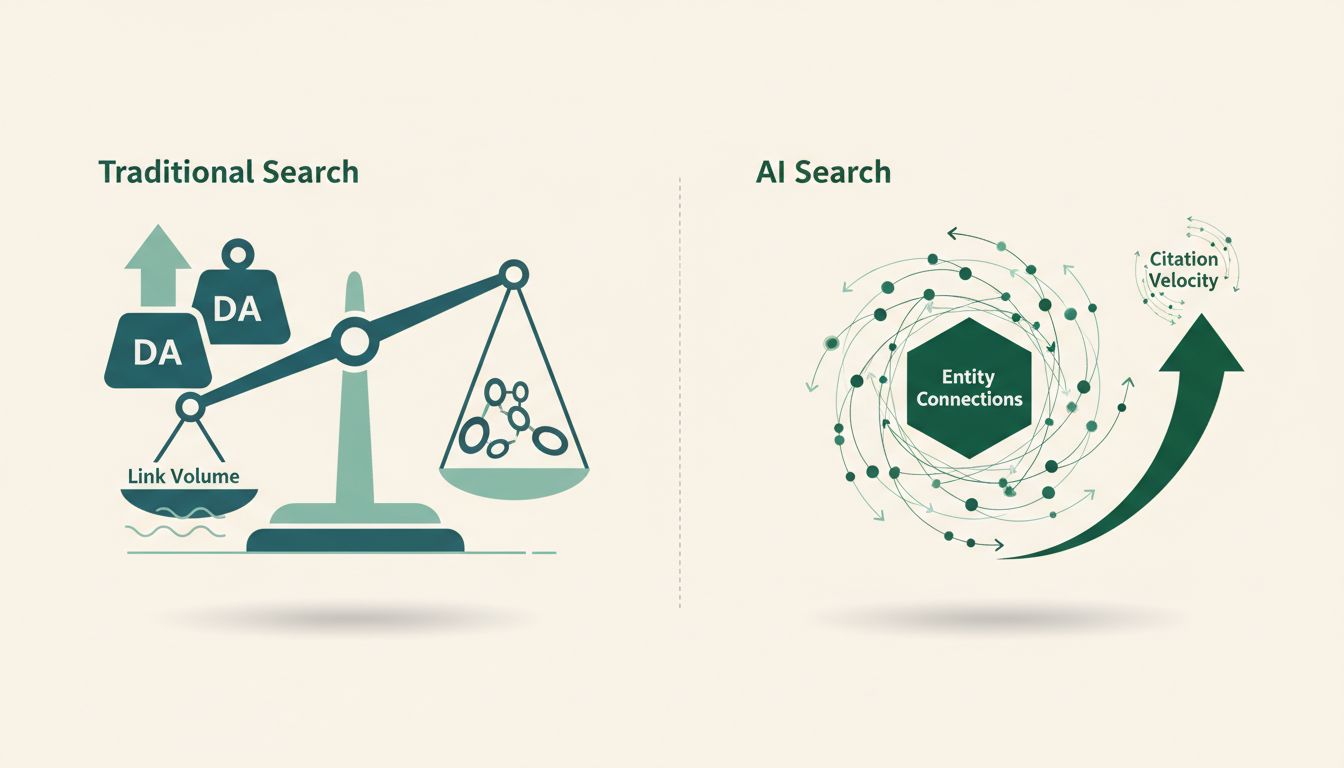
AI search link building adapts traditional tactics for AI-first search environments like Google's SGE. The shift is subtle but real: instead of chasing raw link volume, you now need to earn editorial links, brand mentions, and co-citations that strengthen entity recognition — those are the signals AI retrieval systems actually use.
This guide covers proven tactics, measurement beyond classic metrics, and workflow integration with AI tools while avoiding common pitfalls. I've been testing these approaches myself, and I'll share what I've seen work and what hasn't.
At a glance
- Best tactic
- Original research placements
- Critical metric
- Citation velocity (not just DA)
- Highest risk
- AI-generated outreach without vetting
- ROI timeframe
- 6-12 months
Core differences from traditional link building
AI search prioritizes different signals than the old PageRank-heavy model. The three big ones I see consistently: entity density — clear connections between brands, authors, and topics; citation velocity — the rate of new mentions rather than static authority; and contextual relevance — deep topical alignment over domain metrics.
Example: a cybersecurity firm I worked with earned more AI visibility from one editorial link in Dark Reading than from 50 directory links. That's not an exaggeration — the AI systems saw the contextual match and rewarded it.
For more on how I judge links in this new environment, see How I judge links.
Tactical priority ranking
From most effective to least effective for AI search, based on what I've seen and what the data says:
- Original research placements (e.g., digital PR)
- Expert commentary in industry reports
- Listicle inclusions with contextual links
- Unlinked brand mention reclamation
- Guest posts on tightly relevant sites
- Directories (only niche/vertical)
That bottom tier — directories — is almost always a waste unless you're in a hyper-specific vertical where the directory itself is a trusted source. I've tested both ends of this spectrum, and the gap is wide.
Measurement framework
Tracking beyond classic backlink metrics is essential. Here's what I monitor now:
- Entity graph completeness — Are all key authors/products linked?
- Co-citation frequency — How often are you mentioned with competitors?
- Topical citation share — % of citations in target topic clusters
- SGE appearance rate — Manual checks for AI answer citations
I still use tools like Ahrefs for the basics, but these entity-level metrics tell me more about AI visibility than DA ever did.
AI tools in the workflow
I use AI tools for research and drafting, but never for final relevance judgment. Here's a quick breakdown of what I've tested:
- Ahrefs — Prospecting and gap analysis. Low risk, high utility.
- Semrush — Research and auditing. Solid for agency workflows.
- ChatGPT — Outreach drafts and topic clustering. Medium risk — it can hallucinate prospects.
- Claude — Writing and summarization. Similar risk profile to ChatGPT.
- Perplexity — Source-backed research. Low risk, good for publisher discovery.
- Originality.ai — AI visibility monitoring. Low to medium risk.
The main limitation across all AI tools: they don't validate link quality. You still need to check relevance manually. For more on integrating AI into link building, see ChatGPT AI Link Building.
Pros and cons of AI search link building
Here's my honest assessment after running several campaigns:
Pros: Earns higher-trust links than mass guest-posting; aligns with AI systems' entity and citation preferences; original research compounds across links and mentions; broken-link reclamation is efficient with relevant targets.
Cons: Harder to measure than classic backlink campaigns; requires better assets, raising labor costs; AI tools don't remove manual relevance checks; cheap placements are increasingly low-yield.
For a deeper look at linkable assets, see Linkable Assets.
Pricing and tooling costs
Tooling costs vary widely. SEO suites like Ahrefs and Semrush are typically subscription products; AI writing tools like ChatGPT and Claude are also subscription-based; monitoring or niche AI-visibility tools may add another monthly fee. The bigger cost driver is labor: original research, publisher outreach, and editorial placement usually cost far more than software.
If you're considering buying links, see Buying & hiring for my thoughts on what's worth the money.
Key insight
AI search rewards entity-focused link building with contextual relevance over bulk link counts. That doesn't mean links are dead — it means they work best when bundled with entity signals, mentions, and topical authority.
For more on how this fits into a broader strategy, see Organic Link Building and Link Earning.
AI search tools and their impact on link building
Key tools for AI search link building, their uses, and limitations:
| Tool / platform | Primary use in link building | Best for | Main limitation | Risk profile |
|---|---|---|---|---|
| AhrefsUsed to pull competitor backlinks, organic keywords, and authority gaps before outreach. | Prospecting and gap analysis | Competitor research, keyword mapping, link intersect-style discovery | Not an AI-search visibility tool; it supports workflow, not outcomes | Low |
| SemrushCommonly used for competitive research, backlink audits, and keyword clustering before AI-era pitching. | Research and auditing | Agency workflows, broader SEO teams | Less direct on AI citation measurement | Low |
| ChatGPTUseful for drafting outreach, clustering keywords, and generating pitch angles, but it does not validate link quality by itself. | Ideation and workflow speed | Outreach drafts, topic grouping, prompt-driven research | Can hallucinate prospects or overgeneralize relevance | Medium |
| ClaudeUsed in some AI-link-building workflows for drafting outreach with tighter constraints and cleaner long-form reasoning. | Writing and summarization | Email drafts, content synthesis, SOP support | Still needs human verification of targets and claims | Medium |
| PerplexityUseful for fast source-backed research on publishers, entities, and topic clusters before outreach. | Source-backed research | Publisher discovery, citation-aware background checks | Not a backlink database; limited for scale prospecting | Low |
| Originality.aiMentioned as a way to monitor AI mentions and visibility in some AI-search workflows. | AI visibility monitoring | Brand mention tracking in generated content | Not a replacement for link data or SERP analysis | Low to Medium |
Arguments for
- Earns higher-trust links than mass guest-posting
- Aligns with AI systems' entity and citation preferences
- Original research compounds across links and mentions
- Broken-link reclamation is efficient with relevant targets
Arguments against
- Harder to measure than classic backlink campaigns
- Requires better assets, raising labor costs
- AI tools don't remove manual relevance checks
- Cheap placements are increasingly low-yield
What the experts say
Links are still a strong signal, but context and relevance matter more than ever. Entity recognition is becoming a key part of how we understand content.
The future of link building is about earning mentions and citations, not just links. AI systems are already using co-citations to determine authority.
What it costs (and why prices are unreliable)
Tooling costs vary widely. SEO suites like Ahrefs and Semrush are typically subscription products; AI writing tools like ChatGPT and Claude are also subscription-based; monitoring or niche AI-visibility tools may add another monthly fee. The bigger cost driver is labor: original research, publisher outreach, and editorial placement usually cost far more than software.
Frequently asked questions
How many links needed for AI visibility?
No fixed number — focus on 3-5 authoritative citations per entity cluster quarterly.
Do .edu/.gov links still matter?
Only if contextually relevant. AI weighs topical alignment over domain type.
Can I automate AI search link building?
Partial automation (research/drafting) works, but relevance judgment requires human oversight.
How to find AI-cited publishers?
Manual SGE/Perplexity searches for target queries + tools like Ahrefs for backlink analysis.
What's the #1 mistake?
Prioritizing link volume over contextual entity connections.
Does AI search replace link building?
No. Links still matter, but they work best when paired with entity signals, mentions, and topical authority.
Sources
Every factual claim on this page is drawn from the following independent sources. Links open in a new tab.
- Morningscore — Lists AI-era link building strategies: digital PR, listicle placements, brand mentions, and Reddit participation.
- Stay Digital Marketers — Explains entity-first SEO, topical clusters, co-citations, unlinked mentions, structured data, and internal/external linking.
- Rankz — Advocates editorial links over bulk placements, entity-based authority, and extractable content.
- Authority Builders — Emphasizes semantically aligned publishers, contextual relevance, and honest anchor text.
- PressWhizz — Describes an AI-assisted prospecting workflow using competitor backlinks, enrichment, classification, and outreach generation.
- Geoptie — Recommends topic clusters, semantic coverage, original research, and monitoring AI citation metrics.
- Fokal — Describes broken-link replacement and prioritizing pages AI engines already cite, plus citation-ready structure.
- Bazoom — Argues for relevance over volume, deliberate brand mentions, and measuring citations rather than only rankings.